

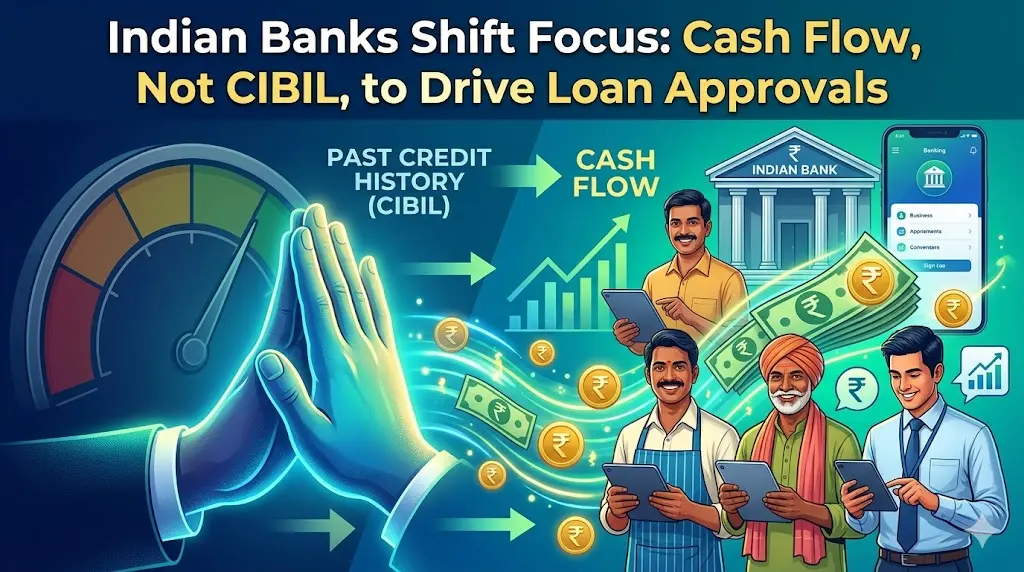
MUMBAI, May 7, 2026 – In a fundamental shift that promises to reshape India’s credit landscape, lenders across the country are increasingly looking beyond traditional CIBIL scores and prioritizing real-time cash flow analysis and digital footprints to assess loan applicants.
The transition marks a departure from decades-old lending practices that heavily relied on credit bureau scores and collateral-based underwriting. Industry experts say the change will unlock formal credit access for millions of “credit-invisible” Indians, including small business owners, gig workers, first-time borrowers and rural entrepreneurs who may have limited borrowing history but demonstrate strong repayment capacity through daily financial transactions.
Beyond the ‘Rearview Mirror’
For years, a high CIBIL score has been considered the golden ticket to loan approval. However, lenders are now recognizing that past repayment history alone does not capture a borrower’s current financial health or future capacity to repay.
“A CIBIL score is a rearview mirror — it tells you where a borrower has been, not where they are headed,” said Raj P Narayanam, Founder and Executive Chairman of Zaggle, in a CNBC TV18 interaction. Industry executives note that lenders are now combining banking data, GST records and transaction-level insights to understand real financial behavior, with credit scores becoming just one input in a wider analytical framework.
Jayant Upadhyay, COO & Co-Founder at Olyv, explained that lending decisions are shaped by present financial capacity rather than past behavior alone. “Income stability, ongoing EMI burden, cash flow predictability and repayment capacity are now core filters in credit evaluation,” Upadhyay said. Even borrowers with strong scores may be flagged if their financial structure appears stretched.
SBI’s Strategic Pivot to Cash-Flow-Based Lending
State Bank of India (SBI), the nation’s largest lender, has emerged as a key driver of this transformation. SBI Chairman C.S. Setty recently announced a major strategic shift, moving from collateral-based lending to cash-flow-based lending for all MSME loans up to ₹5 crore, backed by credit guarantees.
“Up to ₹5 crore, we want to move from collateral-based lending to cash-flow-based lending, backed by guarantee, which will give enough traction to the growth of micro enterprises to become small and small to become medium,” Setty stated.
The transition is designed to address one of the most persistent challenges faced by Micro, Small and Medium Enterprises (MSMEs): limited access to credit due to lack of collateral. By shifting focus to cash-flow-based lending, SBI aims to empower smaller enterprises to expand without the traditional constraints of collateral requirements, which have long trapped MSMEs in what experts term the “collateral trap” — needing assets to get money, and money to get assets.
To support this transition, SBI is collaborating with multilateral development banks and large multinational banks to establish specialized verticals within its operations, recognizing that evaluating emerging sectors requires expertise that is still evolving.
Government-Backed Push for Digital Assessment
The shift is receiving strong support from policymakers. The finance ministry is set to launch a digital credit assessment model for MSMEs this December, leveraging digital footprints to assess creditworthiness and moving away from the earlier requirement of external ratings.
According to ministry officials, the model will capture digital footprints including employee salary payments, utility bills, bank transactions and contributions to provident fund and the National Pension Scheme, enabling banks to assess smaller businesses that may lack formal balance sheets and documentation.
“The credit assessment model for MSMEs will launch next month. The framework is complete and is being piloted,” an official told Moneycontrol on condition of anonymity.
The initiative is integrated with a ₹100-crore credit guarantee scheme that allows MSMEs to secure loans without third-party guarantees or collateral. It also extends beyond working capital to term loans for plant and machinery.
Beyond Credit Scores: The Unified Lending Interface
In a related development, the Department of Financial Services has instructed all banks and financial institutions to integrate with the Unified Lending Interface (ULI), a digital platform that looks beyond credit scores to assess creditworthiness. The platform enables lenders to access verified data from government ministries and departments, utilizing alternative sources such as utility bill payments and GST records to evaluate borrowers.
Crucially, even individuals without a CIBIL score can now have their digital footprint — spending habits, income flow, land records, property ownership and repayment behavior — used to assess creditworthiness. This opens formal credit access to farmers, gig workers, small vendors and others previously excluded from the banking system.
Technology Enables the Transition
The shift to alternative credit assessment is being powered by artificial intelligence and machine learning. By analyzing digital footprints, lenders can build dynamic borrower profiles that evolve in real time. According to a recent report by the Fintech Association for Consumer Empowerment (FACE), 84% of Indian lenders now use a mix of traditional and alternative data for underwriting, blending traditional metrics with emerging signals such as location data, SMS and app usage, utility payments and employment history.
Digital transactions already provide a strong indicator of financial discipline. With UPI recording 613 million daily transactions and 18.40 billion monthly volume as of June 2025, lenders now have unprecedented access to data that can assess spending consistency and repayment intent. Rent and utility bill payments offer another reliable proxy for responsibility, while consistent income inflows reflected in salary credits or GST filings provide additional insight.
Addressing the MSME Credit Gap
The timing of this shift is significant. According to Reserve Bank of India data, an expert committee estimated the credit gap in the MSME sector to be in the range of ₹20 to ₹25 lakh crore. Lenders are increasingly recognizing that traditional collateral-dependent practices have left millions of viable businesses without access to formal credit.
IDBI Bank Deputy Managing Director Sumit Phakka noted that the Union Budget 2026 is reshaping MSME lending, with cash-flow-based financing and digital underwriting taking center stage as the bank scales responsibly while maintaining strong credit discipline.
Challenges and the Road Ahead
Despite the momentum, industry leaders caution that the transition must be gradual. Setty emphasized that while the shift to cash-flow-based lending will alleviate some challenges, it will not eliminate them entirely, requiring guarantees to ensure stability and sustainability.
The depth of credit history also remains relevant. Experts note that diverse, long-term credit usage often signals stronger financial resilience than limited credit activity, and approval outcomes are often determined by current leverage rather than credit history alone.
Shakti Shekhawat, Business Head at BharatLoan, summarized the new paradigm succinctly: “A high CIBIL score opens doors, but it doesn’t walk you through them”.
For millions of aspiring Indian entrepreneurs and first-time borrowers, that door may now finally be within reach.
Leave a Reply
You must be logged in to post a comment.