

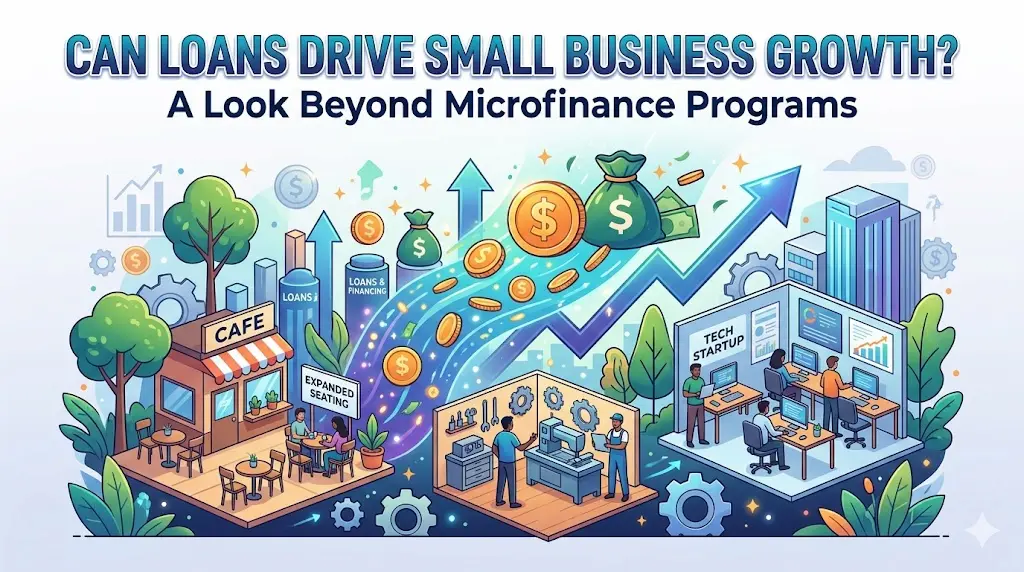
Do loans help small businesses grow? Looking beyond microfinance
For decades, microfinance has been celebrated as a lifeline for entrepreneurs in developing economies—small sums that spark big change. But when we shift the lens to the broader universe of small businesses, from neighborhood bakeries to tech startups, a more powerful story emerges: loans, when tailored and accessible, are not just safety nets but genuine launchpads for sustainable growth.
Yes, loans help small businesses grow. And looking beyond microfinance, the evidence is overwhelmingly positive.
Fueling expansion when it matters most
Every thriving business hits a crossroads: the moment when customer demand outpaces current capacity. A local café needs an espresso machine that won’t break mid-rush. A family-owned hardware store wants to stock seasonal inventory before the competition. An online retailer must double warehouse space to fulfill holiday orders.
Without capital, these opportunities stall. With a well-structured loan, they accelerate. Small business loans bridge the gap between ambition and action, enabling owners to purchase equipment, hire staff, or launch marketing campaigns precisely when timing matters most. Unlike microfinance—which typically offers very small, short-term loans—mainstream small business lending provides the scale needed for meaningful leaps.
Beyond survival: investing in productivity
One of the most encouraging findings from recent economic research is that access to credit doesn’t just help businesses survive—it transforms their productivity. Studies across Europe, North America, and emerging Asian markets show that small firms receiving formal loans invest heavily in better technology, employee training, and supply chain improvements.
Take a small manufacturing workshop that secures a $50,000 term loan. Instead of patching old machinery, the owner buys a CNC machine that triples output and reduces waste. Revenue grows, wages rise, and the business becomes more resilient to economic shocks. This isn’t microfinance—it’s macro impact, delivered through thoughtful lending.
Job creation that ripples through communities
When small businesses grow, communities flourish. The U.S. Small Business Administration has consistently found that small firms create roughly two-thirds of net new jobs. Loans accelerate this trend. A modest loan that allows a cleaning service to add three vans doesn’t just benefit the owner—it creates drivers, dispatchers, and mechanics.
Looking beyond microfinance, we see that larger small-business loans (100,000to1 million) often generate the most dramatic employment gains. These are the “missing middle” loans that help established businesses scale from 10 employees to 50, or from a single location to a regional presence. Each new hire spends wages locally, creating a virtuous cycle.
Innovation without dilution
Many small business owners resist bringing in equity investors, fearing loss of control or creative direction. Loans offer a powerful alternative: growth without giving up ownership. A family restaurant expanding to a second location can take a term loan, repay it from profits, and retain every future decision. A software startup can use a revenue-based loan to hire developers while keeping equity for the founders.
This financial autonomy encourages bolder innovation. Owners invest in unproven ideas, experiment with new product lines, and enter adjacent markets—all while keeping their long-term vision intact. Microfinance rarely provides enough capital for such bets. But mainstream lending certainly does.
The role of smarter, more inclusive lending
Of course, not all loans are equal. The positive story requires responsible underwriting, fair interest rates, and repayment terms that match business cycles. Fortunately, the lending landscape is evolving. Online lenders, community development financial institutions (CDFIs), and fintech platforms now offer faster approvals, flexible terms, and data-driven risk assessment. Many explicitly focus on underserved groups, including women-owned and minority-owned businesses.
Guaranteed loan programs, like those offered by the SBA or similar agencies globally, further reduce risk for lenders while expanding access for borrowers. The result: more small businesses getting capital when they need it, on terms they can actually manage.
Real-world success: beyond the anecdote
The optimism isn’t theoretical. A 2022 study tracking thousands of small firms across 15 countries found that those receiving loans of $25,000 or more showed 30–40% higher revenue growth over three years compared to peers without access. Another analysis of European data linked small business lending directly to increased R&D spending and patent filings.
Even during economic downturns, access to credit helps small businesses pivot. Loans taken during COVID-19 allowed restaurants to build outdoor seating, retailers to launch e-commerce sites, and manufacturers to retool for PPE production. Survival turned into reinvention.
A final thought: loans as tools, not crutches
To be clear, loans are not gifts. They require discipline, a solid plan, and the willingness to repay. But for the millions of small business owners with a proven track record and a clear growth opportunity, borrowing is one of the most effective tools available. It unlocks capital that microfinance cannot provide, empowers owners to stay independent, and creates jobs that strengthen entire economies.
Looking beyond microfinance, the answer is unequivocal: yes, loans help small businesses grow. And when done right, everyone benefits—the entrepreneur, the employees, the customers, and the community. That’s a story worth celebrating.
Leave a Reply
You must be logged in to post a comment.